Spanish vs Catalan: which one should you learn first?
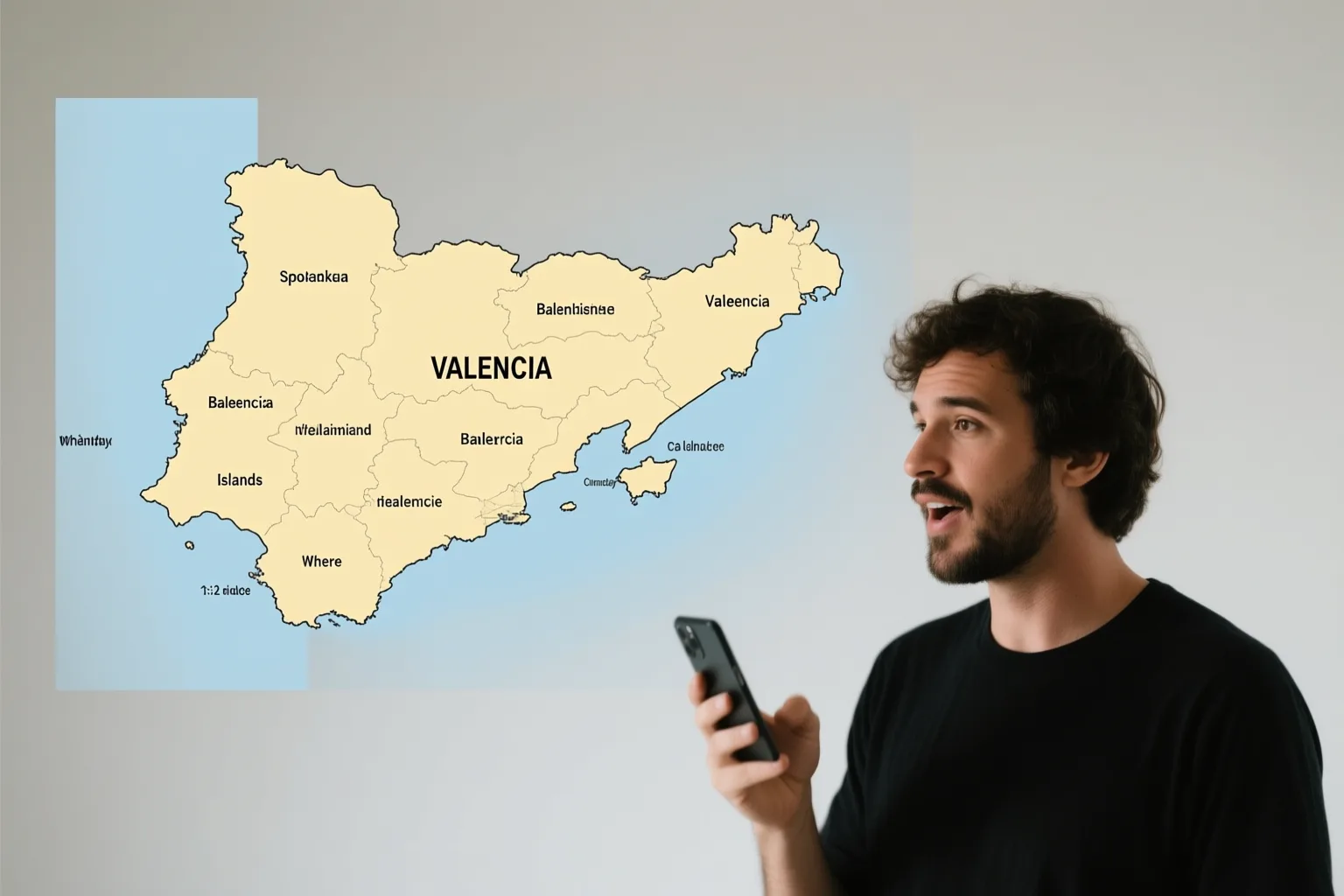
Spanish is the practical default: 500 million native speakers, phonetic spelling, and a grammar system that stays consistent across continents. Catalan is the local key: 9–10 million speakers concentrated in Catalonia, Valencia, the Balearic Islands and Andorra, with vowel sounds and verb forms that feel familiar if you already know Spanish or French. Choose Spanish if you want one language for travel, work or media across twenty countries. Choose Catalan if you live, work or put down roots in its territory — or if you already speak Spanish and want the next Romance language that pays off fast.
The core differences in five minutes
Pronunciation — Spanish has five clean vowels. Catalan has eight (including open and closed e/o plus a schwa in Eastern dialects), so casa sounds different in Barcelona than in Madrid. Consonants are mostly shared, but Catalan keeps final consonants (cant vs Spanish canto) and has the ny /ɲ/ and ll /ʎ/ sounds that Spanish writes ñ and ll but pronounces differently.
Grammar — Both are Romance, so gender, agreement and subjunctive exist in both. Catalan adds a periphrastic past (vaig cantar 'I sang') that Spanish lacks, and its clitic pronouns climb higher in the sentence (el veig vs lo veo). If you know Spanish, the patterns click quickly; if you start from zero, Spanish regularity wins the first month.
Vocabulary — About 85 % of everyday words are cognates. Finestra / ventana, cotxe / coche, feina / trabajo. The false friends are few (llarg means 'long', not 'large'). Learning the second language after the first is mostly swapping labels, not relearning concepts.
Official status — Spanish is the sole official language of Spain and most of Latin America. Catalan is co-official in Catalonia, the Balearic Islands and Valencia (where it is called valencià), and the only official language of Andorra. In those regions, public services, schools and many workplaces operate in Catalan by default.
Which is easier for an English speaker?
Spanish. The vowel system maps cleanly to English, spelling is almost perfectly phonetic, and the verb paradigms, while numerous, follow predictable patterns. Catalan's extra vowels, dialectal variation (Eastern vs Western) and the periphrastic past add a layer of friction in the first 50 hours. After that, the gap narrows: a Spanish speaker reaches conversational Catalan in roughly half the time it took to reach the same level in Spanish from scratch.
Real-world use cases
| Goal | Better choice | |------|---------------| | Travel across Spain + Latin America | Spanish | | Live in Barcelona, Valencia, Palma or Andorra | Catalan | | Work for a multinational with Spanish-speaking markets | Spanish | | Work in Catalan public sector, education, healthcare | Catalan | | Consume media (Netflix, podcasts, news) | Spanish (volume) + Catalan (local depth) | | Already speak Spanish, want a third Romance language | Catalan (high leverage) |
Learning order: start with one, add the other
If you know neither — Start with Spanish. Reach A2 (basic conversations, present + past + future) in 80–120 hours of spoken practice. Then add Catalan; the shared grammar cuts the curve to 40–60 hours for the same level.
If you already speak Spanish — Start Catalan tomorrow. The periphrastic past, clitic climbing and vowel distinctions are the only real hurdles. Five minutes a day speaking with a Langel gets you to functional Catalan in weeks, not months.
If you already speak Catalan — Spanish feels like a wider, flatter version of what you know. Drop the periphrastic past, flatten the vowels, learn the ñ/ll sounds — done.
Resources that match the goal
- Spanish first: any graded reader, podcast for learners, or a Langel set to Talk to me for daily spoken practice.
- Catalan first: Parla.cat (free official courses), Assimil Català, or a Langel that speaks Catalan natively and corrects your obert vs oberta inside the reply.
- Both in parallel: alternate days. Spanish on Mon/Wed/Fri, Catalan on Tue/Thu/Sat. The brain separates them better than mixing in one session.
With a Langel
You: I'm moving to Valencia in three months. Should I learn Spanish or Catalan first?
Langel: Start with Spanish — you'll use it everywhere in Spain and beyond. Once you can order coffee and ask directions, flip the dial to Teach me and we'll swap the Catalan equivalents: café → café, gracias → gràcies, ¿dónde está…? → on és…?. Five minutes a day, and you'll land with both.
You: What about the vowel sounds? I hear Catalan has more.
Langel: Eight vs five. The new ones are open/closed e and o plus the schwa in Barcelona (the first a disappears). I'll say a pair — casa / casa, porta / porta — you repeat, I correct inside the reply. No drills, just conversation.
You: And if I already speak Spanish?
Langel: Then we skip the shared grammar. We'll target the periphrastic past (vaig anar), clitic climbing (el veig), and the vowel contrasts. You'll hear the difference in your own voice by session three.
Frequently asked questions
Is Catalan a dialect of Spanish?
No. Catalan is a separate Romance language, closer to Occitan and French than to Spanish. It has its own literature, grammar and official status.
Can I get by in Barcelona with only Spanish?
Yes, everyone understands Spanish. But signs, menus, school meetings and many workplace conversations default to Catalan. Speaking it changes how locals respond to you.
How long to reach conversational Catalan if I know Spanish?
40–60 hours of spoken practice. The vocabulary and grammar overlap does most of the heavy lifting.
Which has more learning resources?
Spanish — by an order of magnitude. Catalan has solid free courses (Parla.cat, Intercat) and a growing podcast scene, but fewer graded readers and apps.
Does learning Catalan help with French or Italian?
Yes. Catalan sits between Occitan and Iberian Romance; its vowel system and verb morphology make French and Italian feel familiar faster than starting from Spanish alone.

Related guides
- AP Spanish conversation practice: how to prepare for the speaking tasks out loudAP Spanish conversation practice is timed, spoken and unscripted. How to train the simulated conversation daily, alone or with a partner who answers.
- How Langels works for Spanish: voice practice that fits your dayLangels gives you a Spanish voice partner who replies in real time, corrects inside the conversation, and remembers what you said last time. Five minutes…
- How to Ask for the Bill in SpanishSay 'La cuenta, por favor' or '¿Me trae la cuenta, por favor?' to ask for the bill in Spanish; both are polite and understood everywhere.